Picture this: A massive storm is approaching. You look out your window and realize the big oak tree in your front yard has branches scraping against your roof. If they break, they will smash a hole right through your living room ceiling.
You panic and call a Tree Service company. A man in a hard hat comes out, looks up, and hands you a quote: $750 to remove three branches. Why? Because he has to bring a bucket truck, a crew of three guys, and carry $2 million in liability insurance.

- 10” Long Pruning Saw: Fit for heavy work, powerful and strong enough, can cut through branches with 6” diameter with eas…
- Sharp Blade: WEIMELTOY Large tree trimming Saw with SK5 material, flexible and durable, triple sharpen blade,been harden…
- Soft Handle:Our Pruning folding hand saw with rubber soft handle, comfortable to grip even for a long time, non-slip, en…
The tree care industry is one of the most overpriced scams in home ownership. They know you are terrified of heights and falling branches, so they hold your roof hostage for nearly a thousand dollars. But you don’t need a bucket truck to cut a branch. You just need the right reach. Here is the dirty truth about tree trimming, and how to do it yourself safely:
The “Landscaper vs. Arborist” Lie People think they need a certified Arborist (tree surgeon) just to cut a branch. An Arborist charges a $200 consultation fee just to look at the tree.
- The Free Hack: If the tree is healthy and you are just cutting branches that are touching your roof or blocking your walkway, you don’t need a tree surgeon. You are doing “maintenance pruning,” which any homeowner can do. Identify the branch collar (the swollen ridge where the branch meets the trunk) and cut just outside it. The tree will heal itself naturally.
- The Extra Benefit : Trimming your own trees allows you to shape them to provide perfect afternoon shade over your patio in the summer, while letting sunlight hit your roof in the winter to melt snow. You control the tree’s shape, saving $200 on “expert” advice.
The “Ladder and Chainsaw” Death Trap The most dangerous thing a homeowner can do is balance on an aluminum extension ladder while trying to hold a heavy, vibrating gas chainsaw above their head.

If the branch kicks back, the chainsaw hits your shoulder. If the ladder shifts, you fall 15 feet onto concrete. This is why insurance companies charge tree services so much.
- The Smart Fix: Keep your feet firmly on the ground. Use a manual rope saw. It is a 50-foot length of tough polyester rope with a chainsaw blade woven into the middle. You throw the rope over the branch, grab both ends, and pull back and forth. The blade cuts through a 10-inch branch from the ground in 5 minutes.
- The Extra Benefit : Using a rope saw from the ground guarantees you will never fall. More importantly, when the branch finally snaps, it doesn’t swing back and hit you in the face. The rope absorbs the shock, making it the safest way to drop heavy limbs.
The Telescopic Power Tool (The Pole Saw Secret) If you have a lot of branches to cut, pulling a rope saw gets exhausting. But you still don’t want to use a ladder.
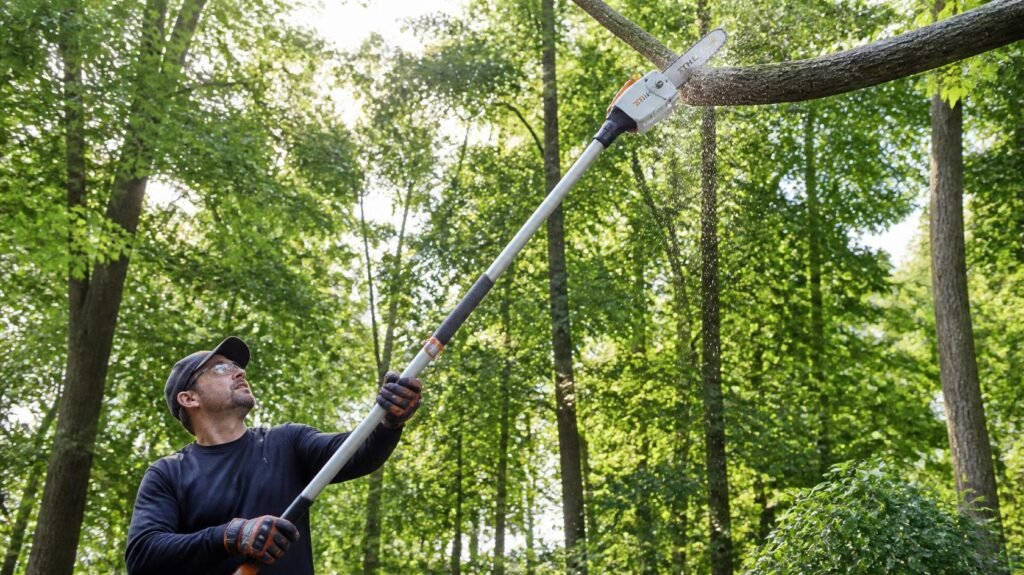
- The Smart Move: A Cordless Pole Saw is the ultimate homeowner cheat code. It is a mini chainsaw mounted on the end of an 8-to-10-foot telescoping pole. You extend the pole, hold the saw up to the branch, and pull the trigger. It slices through thick branches in seconds while your feet are safely planted on the grass. It completely eliminates the need for a $750 tree service crew. (If you want to see which pole saws have the longest reach without being too heavy to lift, check out our review of the best budget cordless pole saws!)
- The Extra Benefit : A pole saw doesn’t just cut branches. You can detach the saw head and use it as a mini-chainsaw to cut up the fallen branches for firewood. You turn a $750 expense into a free stack of winter firewood that saves you $300 on your heating bill.
The Bottom Line Stop letting tree service companies extort you out of $750 just because a branch is near your roof. Learn where to cut, stay off the ladder, and invest in a cordless pole saw. You can protect your roof and your wallet from the ground.
Disclosure: This post contains affiliate links. If you click through and make a purchase, we may earn a small commission at no extra cost to you. We only recommend products we genuinely believe offer great value.