You are trying to park your car in the garage, but it is completely full of cardboard boxes. You have winter coats, heavy blankets, and Christmas decorations taking up every inch of space.
Frustrated, you drive to a “Self-Storage” facility. The salesman tells you it’s only $150 a month for a 10×10 unit. It sounds like a great deal to get your garage back. Fast forward 3 years: You have paid them $5,400, and you haven’t visited the unit once. You are literally paying a mortgage on a pile of junk you forgot you owned.
The self-storage industry is a massive financial parasite. They prey on your inability to let go of things, charging you thousands of dollars to store items that are barely worth a few hundred. You don’t need to rent a metal cage to declutter your house. You just need to understand space compression. Here is the dirty truth about storage, and how to reclaim your home for pennies:
The “I’ll Need It Someday” Lie People hold onto boxes of old clothes and baby toys because they think they will need them “someday.”
- The Free Hack: Apply the “2-Year Rule.” If you have not used an item, worn a piece of clothing, or opened a box in the last 24 months, you do not need it. Donate it, sell it on Facebook Marketplace, or throw it away. Do not pay $150 a month to store a $10 sweater.
- The Extra Benefit : Donating old clothes provides a tax write-off that can increase your annual tax refund by hundreds of dollars. Plus, clearing physical clutter from your home has been scientifically proven to lower cortisol levels, curing the “anxiety” you feel when you walk into a messy room.

- 【Modern Curved Edge Design】 Add a stylish touch to your home with this walnut 15 cube storage organizer featuring a dist…
- 【Spacious 15 Cube Storage】 Make the most of your vertical space with this large 15 cube storage organizer featuring 15 o…
- 【Fits 11×11″ Storage Bins】 Each spacious cube is designed to accommodate 11×11″ storage bins, giving you flexible option…

- [Upgraded Sturdy & Reliable Support] Our shelves built with 1mm thickened main frame and 4mm solid steel wire, not benda…
- [Ultra Stable & Anti-Wobble] 3 support bars per layer, 12 reinforcing bars total, with diagonal braces to help avoid tip…
- [Tidy Space & Peaceful] Cluttered tools, parts, and supplies can be frustrating. Our shelf comes with 4 write-on, wipe-o…
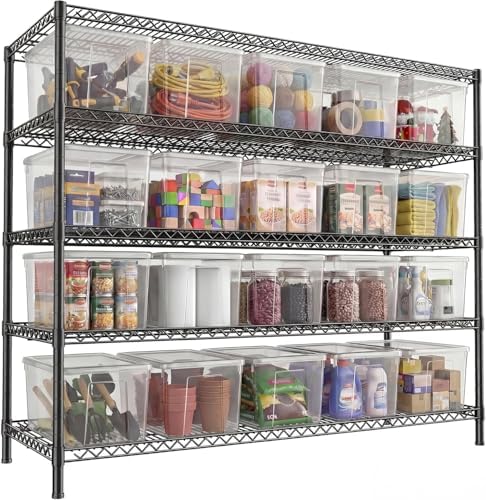
- 【55.5″ W X 18”D X 71″ H Multipurpose storage shelves】The professionally garage shelving with perfect size is suitable f…
- 【3200LBS Load Capacity with 3 V-type Reinforced Braces】Constructed with sturdy heavy duty steel wire and 25mm diameter m…
- 【Adjustable Shelving Unit & DIY Free Combination】 The metal shelving unit allows for vertical adjustment between shelves…
The “Cardboard Box” Moisture Trap People pack their winter clothes in cardboard boxes and shove them in the garage. Cardboard absorbs moisture from the air. Within months, your clothes smell like mildew, and silverfish and mice have chewed through the boxes to make nests.
- The Smart Fix: Never use cardboard for long-term storage. Use clear, airtight plastic totes. They keep moisture, bugs, and dust out completely. You can see what is inside without opening them.
- The Extra Benefit : Clear plastic totes are waterproof. If your garage or basement floods, your valuable winter coats and photo albums stay perfectly dry and safe, saving you thousands in water-damage replacements.
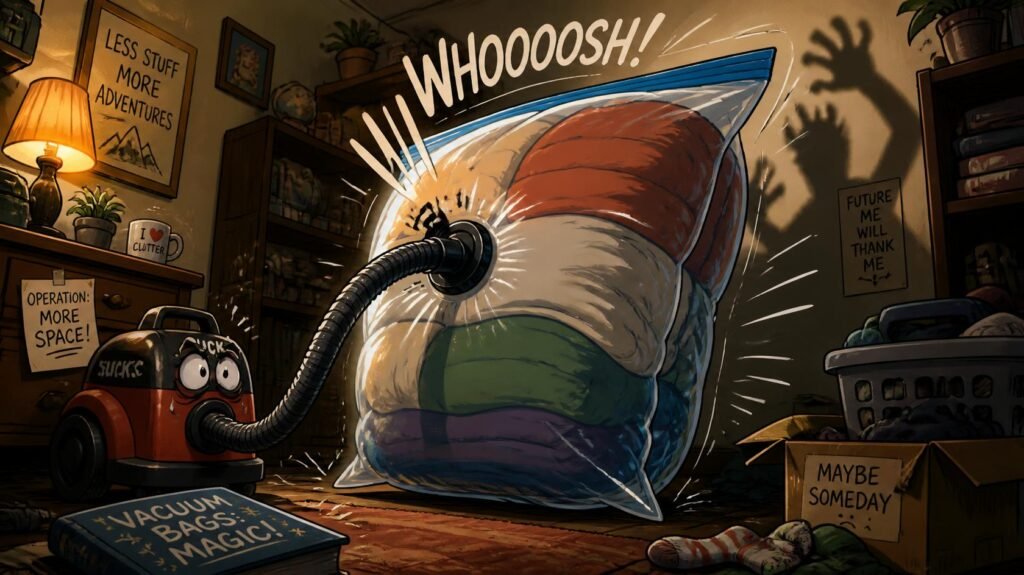
The Air Evacuation Secret (The Vacuum Bag Trick) The biggest space hogs in your home are bulky fabrics: winter jackets, comforters, and pillows. They are 80% air. If you remove the air, they turn into flat pancakes.
- The Smart Move: Vacuum Storage Bags are the ultimate space-saving cheat code. You put three massive winter coats and a thick blanket into a plastic bag, seal it, and suck the air out with your standard vacuum cleaner. The bag shrinks down to 1 inch thick. You can slide 10 of these bags under a single bed, completely eliminating the need for a $150/month storage unit. (If you want to see which bags don’t leak air after a month, check out our review of the best vacuum storage bags!)
- The Extra Benefit : Vacuum bags create an airtight seal that suffocates dust mites and prevents moths from eating your expensive wool sweaters. When you open the bag next winter, your clothes will smell factory-fresh and be 100% bug-free.
The Bottom Line Stop paying a storage facility $2,000 a year to hold your forgotten junk. Apply the 2-year rule, use plastic totes, and compress your bulky fabrics with vacuum bags. You can fit your entire garage into your closets and keep your cash.
Disclosure: This post contains affiliate links. If you click through and make a purchase, we may earn a small commission at no extra cost to you. We only recommend products we genuinely believe offer great value.