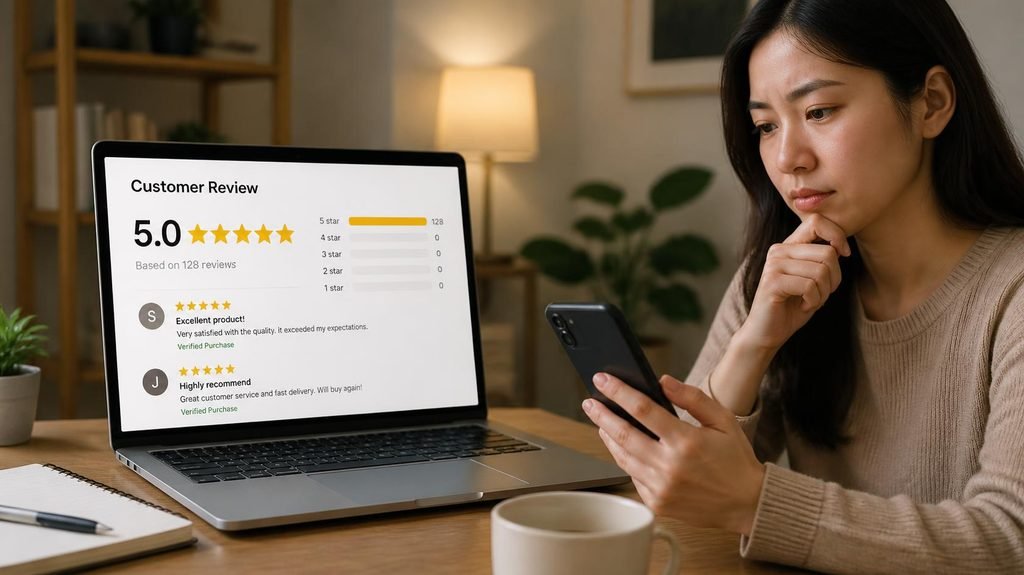
Here’s an uncomfortable statistic: analysts estimate that a meaningful chunk of online reviews are fake — paid for by sellers, written by bots, or swapped in batches. Which means the “4.8 stars, 12,000 reviews” you’re trusting might be partly theater.
The good news: fake reviews have fingerprints. Once you know the nine tells below, you’ll never read a review section the same way again.
Red Flag #1: The review flood.
Click “sort by date” instead of “most helpful.” Real products earn reviews in a slow, steady drip for years. Fake ones arrive in a flood — hundreds of reviews within a few days or weeks, often right after launch. A product with 5,000 reviews where 4,000 arrived in one month? That’s a purchased wave.


Red Flag #2: Generic praise, zero specifics.
Real people remember specifics: “the battery got me through two flights,” “the zipper broke after a month,” “my kid dropped it in the pool and it survived.” Fakes speak in vague superlatives: “great product, highly recommend, excellent quality!!” If a review could describe literally any product on Earth, it probably wasn’t written by someone who owned this one.
Red Flag #3: A suspiciously perfect ratio.
Nothing is loved by 97% of buyers. Genuinely good products cluster around 80–90% five-star with a real tail of complaints. When you see thousands of reviews with a near-perfect score, scroll to the critical reviews — if the 1-star section is tiny and oddly generic (“didn’t like it”), negative reviews may have been suppressed or buried.
Red Flag #4: The same phrases, recycled.
Read ten reviews in a row. If three of them contain identical or near-identical phrases (“I bought this for my husband and he loves it”), you’re reading copy-paste work from a review farm. Fake reviewers get the same instruction sheet.
Red Flag #5: Reviews that don’t match the product.
Scroll far enough on a suspicious listing and you’ll find it: reviews describing a different color, a different feature, a different item entirely. This happens when sellers “hijack” a listing — swapping a well-reviewed product’s page to sell a different, worse product. The old reviews stay, the product changes. If the reviews feel like they’re about something else… they are.
Red Flag #6: One-day wonders.
Click a reviewer’s profile (most platforms allow this). A real human has history: a mixed bag of purchases, varied writing styles, reviews written months apart. A fake account has often reviewed dozens of unrelated products — a blender, a dog toy, a laptop, a fishing rod — all within the same 48 hours, all five stars.
Red Flag #7: Perfect photos that look too perfect.


Real buyers photograph products on kitchen tables, in cars, in bad lighting — with coffee rings. Fake reviews often attach studio-quality images lifted from the seller’s own page. If every “customer photo” looks like marketing material, it is marketing material.
Red Flag #8: Reviews that fight the criticism.
In the 2–3 star section (the most honest part of any listing), read what people actually complain about. On fake-reviewed products, you’ll sometimes find genuine customers describing real flaws — a hinge that snaps, a battery that dies in a month — while the 5-star section swears perfection. Trust the middle reviews; they have no incentive either way.
Red Flag #9: Timing around big sales events.
Before major shopping events, review counts on certain products jump inexplicably. Sellers know reviews convert browsers to buyers, and they top up before the traffic arrives. That “sort by date” check from Red Flag #1 catches this instantly.
The 60-second habit that replaces all of this:
- Sort reviews by most recent — check the rhythm, not the flood.
- Read three reviews in the middle ratings (3–4 stars) — this is where honest specifics live.
- Click one reviewer’s profile — human or farm?
- Search the product name + the word “complaints” outside the store entirely.
None of this means never trusting reviews — the system still mostly works, and the fake-review problem is worst in hyper-competitive categories like supplements, phone accessories, and no-name electronics. But ten minutes of skepticism before a purchase is the cheapest insurance in shopping. The best review is the one you can’t fake: your own criteria, checked in person, after reading the honest middle.
Disclosure: This post contains affiliate links. If you click through and make a purchase, we may earn a small commission at no extra cost to you. We only recommend products we genuinely believe offer great value.