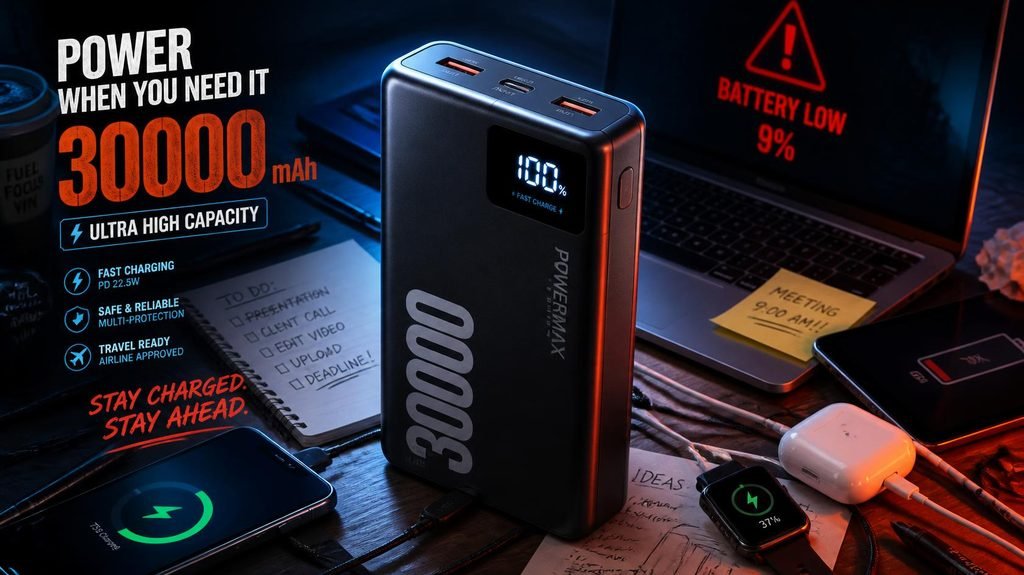
Here’s a story that ends in mild betrayal: you buy a 10,000mAh power bank. Your phone battery is 5,000mAh. Simple math says two full charges. You get one, maybe 1.2 if you’re lucky — and you quietly wonder if you got scammed.
You didn’t. You just did the math the manufacturer’s marketing hopes you’ll do. Here’s the real math.
mAh is a fuel tank measurement — nothing more.
mAh stands for milliampere-hour: how much current a battery can deliver over an hour. A 10,000mAh power bank genuinely holds that much energy — but at its internal cell voltage of 3.7 volts.
Your phone’s charging port runs at 5 volts (or higher). Converting 3.7V to 5V, plus heat lost during conversion, plus losses in the cable, means the power bank’s real-world efficiency is around 60–70%.
The worked example:

- Powerful yet Compact: Boasting a 1,500W AC output and a 3,000W surge peak, the Solar Generator 1000 V2 can power multipl…
- One Hour Fast Charging: Charge your Explorer 1000 v2 Portable Power Station from 0% to 100% battery level in just one ho…
- 10 Year Lifespan: The Explorer 1000 v2 portable power station is equipped with a durable LFP battery, maintaining over 7…
10,000mAh × 0.65 (typical efficiency) = 6,500mAh actually delivered.
Your phone then loses another 10–15% converting incoming power into battery charge. Net result: about 5,500mAh reaches your battery. For a 5,000mAh phone — that’s the 1.1 charges you experienced. The math checks out; the marketing just skipped the asterisk.
The rule of thumb you’ll never forget:
Divide the advertised number by 1.5 to estimate realistic output. Or flip it: for two full phone charges, buy a bank roughly three times your phone’s battery capacity.
What size fits whom:
- 5,000mAh — a pocket top-up, about half a charge. For emergencies, not weekends.
- 10,000mAh — the sweet spot. Roughly 1.5 phone charges, fits in a jacket pocket, no charging anxiety on a normal day.
- 20,000mAh — flights, festivals, camping: 3–4 charges. Nearly all come with two ports so you can share.
- Above 27,000mAh — read this carefully: airlines cap carry-on batteries at 100 watt-hours, which at 3.7V works out to roughly 27,000mAh. Anything bigger is not allowed on the plane, period.
Two specs people confuse: capacity vs. speed.

- Massive 50000mAh Capacity for Long-Lasting Power: Stay powered wherever life takes you with a high-capacity 50000mAh por…
- Built-In 2 Cables for iPhone and USB-C Devices – Ready to Charge Anytime: Leave extra charging cables behind. This porta…
- 3-Year Replacement & Multi-Shield Safety: Built with fire-retardant materials and certified protection against overcharg…

- Ultra-Lightweight: At only 7.5 lbs, the Explorer 300 delivers a robust 292Wh capacity while remaining 17% lighter than t…
- Versatile Power for 6 Devices: Equipped with 2 AC outlets, a 100W USB-C PD port, 2 USB-A ports, and a 120W car port. Wit…
- Built to Last: Upgraded with premium LiFePO4 chemistry, this portable generator delivers over 4,000 charge cycles before…

- [POCKET-SIZE 20000mAh.] Massive power for your pocket. Note: True 20,000mAh requires solid, high-density cells (approx. …
- [DETACHABLE NYLON LANYARD.] Forget extra cords. The built-in USB-C cable acts as a convenient lanyard. Woven with ultra-…
- [TRUE 22.5W FAST CHARGE.] Stop waiting. Blast your Samsung S25 to 70% or iPhone 16 to 60% in just 25 minutes. Built-in t…
mAh is the tank size — how many charges. Watts is the pump speed — how fast each charge fills. A huge 30,000mAh bank with a 10W output will charge your phone at a crawl; a slim 10,000mAh bank with a 22W USB-C Power Delivery port can hit 50% in 30 minutes on modern phones. When comparing banks, look for “PD” or output wattage of 20W or more — that’s the number that decides your wait time.
How to spot an honest brand:
Well-labeled power banks print two numbers: cell capacity (the marketing number) and rated capacity (the realistic output, often stated “at 5V”). Brands that publish the rated capacity are telling you the truth up front. Brands that only print the big number? Now you know what it’s worth — divide by 1.5 and smile.
Disclosure: This post contains affiliate links. If you click through and make a purchase, we may earn a small commission at no extra cost to you. We only recommend products we genuinely believe offer great value.