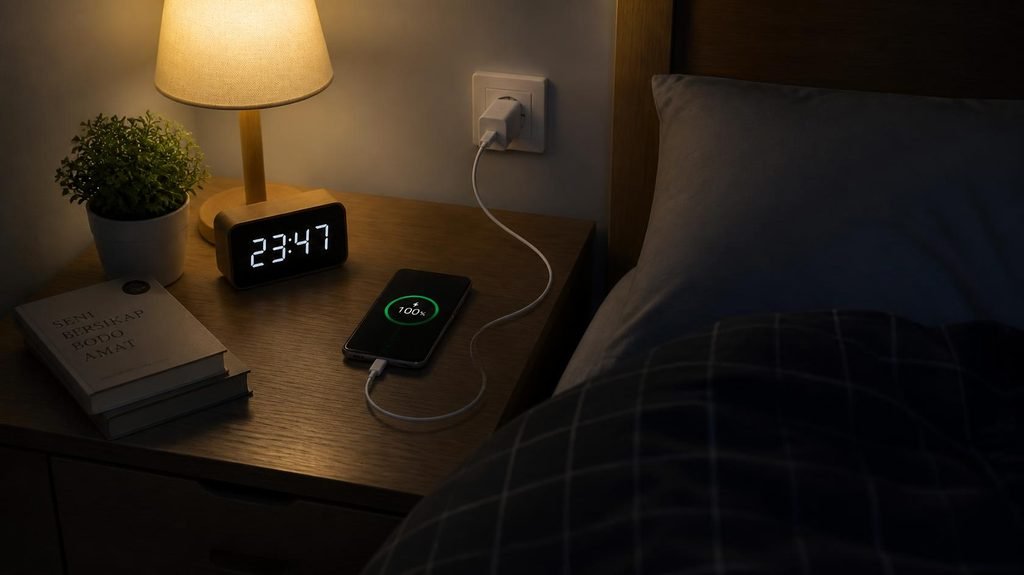
Everyone has a “battery rule” they religiously follow — passed down from a cousin, a phone shop guy, or a 2010 forum post. The problem: almost all of these rules were true for the batteries of 20 years ago. Modern lithium-ion batteries play by different rules, and following the old ones can actually shorten your battery’s life. Let’s clear the five biggest myths.
Myth #1: “Charging overnight destroys your battery.”
The truth: Modern phones stop charging at 100% — full stop. The charging circuit cuts off completely, and the phone then runs off the wall power, occasionally “topping up” a percent or two. The overnight damage myth came from ancient nickel batteries that genuinely overcharged.
The only real overnight risk is heat: charging under a pillow or blanket traps warmth, and heat is the true enemy. Charge overnight on a hard surface, and you’re fine.

- Charge 4 Devices Without Compromise: Enjoy consistent and convenient charging for all your gear thanks to 2 USB-C ports …
- Dual-Port Fast Charging with 50W Max Output: Even with both ports used, USB-C1 maintains full 30W output and USB-C2 char…
- AirPods-Sized and Travel-Ready: Tucks easily into your bag or pocket with built-in foldable plugs for flexible, portable…
Myth #2: “Drain it to 0% to calibrate the battery.” — Stop this one today.
The truth: This advice died with nickel-cadmium batteries in the 1990s. Lithium-ion batteries hate deep discharge. Every trip to true 0% stresses the chemistry and permanently reduces capacity — in fact, the phone shuts itself off at “0%” precisely to protect the cells from the real danger zone below it.
There is one narrow exception: occasionally draining to 0% and fully recharging re-calibrates the battery percentage display (the number on screen), not the battery itself. That’s a once-a-year thing at most, not a habit.
Myth #3: “Fast charging ruins your battery.”
The truth: Half-true, and the truth is more interesting. Fast charging doesn’t damage batteries by speed — it damages by heat. Modern fast-charging systems manage this cleverly: they charge at maximum speed only in the 0–70% range (when the battery is cool and receptive), then slow down for the final stretch.
What actually degrades batteries: cheap third-party chargers with poor voltage regulation, and charging in hot environments (a car dashboard in summer). Use a decent charger in a cool spot, and 30-minute fast charging is perfectly healthy.
Myth #4: “Don’t use your phone while it charges — it can explode.”
The truth: Using your phone while charging is safe — it charges slower, nothing more. Your phone draws power from the wall, not from the battery, while plugged in.
The genuine danger has nothing to do with usage: it’s counterfeit chargers. Off-brand chargers with fake safety certifications have caused real fires. The scary stories you’ve heard almost always trace back to a $3 charger, not to texting-while-charging.
- Charge 4 Devices Without Compromise: Enjoy consistent and convenient charging for all your gear thanks to 2 USB-C ports …
- Dual-Port Fast Charging with 50W Max Output: Even with both ports used, USB-C1 maintains full 30W output and USB-C2 char…
- AirPods-Sized and Travel-Ready: Tucks easily into your bag or pocket with built-in foldable plugs for flexible, portable…

- Super Fast Charging Samsung 25 Watt Charger : Equipped with a PPS/PD type-c port, with adaptive fast charging PPS techno…
- Super Fast Type C Charger: For samsung galaxy a18 5g charger kit for Samsung Galaxy A18 A17 A16 A15 A14 A13 A57 A37 A26 …
- Safety Assurance: The samsung galaxy a17 5g phone charger is certified by CE, FCC, and RoHS. For Samsung galaxy A18/A17/…

- 【60W Fast Charger 2-Pack】: This 2-pack 60W USB-C charger set is built with PD 3.0 PPS technology and delivers a full 20V…
- 【Universal Compatibility】: Designed for Samsung Galaxy S26/S25/S24/S23 series, and compatible with iPhone 18/17/16/15 se…
- 【6FT USB-C to USB-C Fast Charging Cable 2-Pack】: The kit includes two USB-C to USB-C cables, each featuring a reversible…
Myth #5: “There’s nothing I can do about battery aging anyway.”
The truth: Battery aging is chemistry, not fate — and you control the two biggest factors:
- Heat: keep the phone out of direct sun, hot cars, and under pillows. A battery that lives cool easily outlasts one that lives hot by a full year or more.
- Depth of discharge: batteries age by cycles, and a cycle is counted cumulatively. Discharging 100%→0% once is one full cycle — but so is 80%→20% spread over four days. Staying in the middle range (roughly 20–80%) means dramatically fewer deep-stress events per year.
iPhone users can watch this science in action: Settings → Battery → Battery Health shows the exact wear on their battery. When that number drops near 80%, the battery qualifies for a cheap replacement — and a degraded battery is also one of the sneaky reasons phones slow down, as we explained in our full guide on why phones get slow.
The bottom line: charge overnight if you want, never chase 0%, keep it cool, and be suspicious of $3 chargers. Your battery will thank you with an extra year of life.
Disclosure: This post contains affiliate links. If you click through and make a purchase, we may earn a small commission at no extra cost to you. We only recommend products we genuinely believe offer great value.