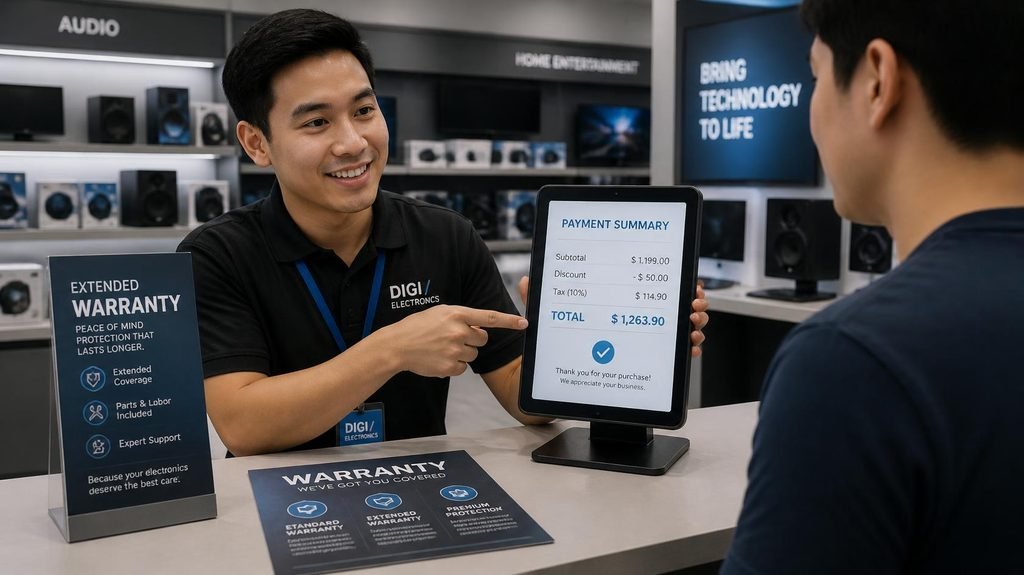
It always happens at the worst possible moment — the checkout screen. You’ve spent 40 minutes picking the perfect $500 laptop, you’re one click from done, and then:
“Add 3-year protection for $129?”
The phrasing is deliberate: protection, peace of mind, what if something happens. Let’s actually answer that question with numbers instead of fear.
Exhibit A: Who actually profits here?

- Get your money as soon as the next business day.
- Get set up quickly with no long-term commitments. Download the Square Point of Sale app for free, create an account, and…
- Run your business all in one place with the free Square Point of Sale app. Track your sales, manage inventory, accept ti…
Extended warranties are among the most profitable products retailers sell — historically generating profit margins that dwarf the electronics themselves. Big-box electronics stores have openly reported that warranties and subscriptions carry a huge share of their profitability. That’s why cashiers are trained (and sometimes pressured) to pitch them on every single sale. When a product line is that profitable for the seller, the math is usually bad for the buyer.
Exhibit B: The expected-value calculation.
Here’s the honest math nobody does at the checkout screen. Say the warranty costs $129, and there’s roughly a 15% chance your laptop needs a $300 repair within the coverage window:
0.15 × $300 = $45 of expected coverage.
You’re paying $129 for $45 of insurance. That’s not peace of mind — that’s a 3x markup on risk. And the real-world odds are often even friendlier than 15%, which brings us to the next exhibit.
Exhibit C: When things actually break.
Electronics failures follow a “bathtub curve”: defects cluster in the first year (already covered by the free manufacturer warranty) or after year four (after your extended plan expires). The extended warranty is priced to cover the middle — statistically the calmest stretch of a device’s life.
Exhibit D: The fine print that eats claims.
Even when something does break, the plan fights back:
- Accidental damage usually isn’t covered unless you paid extra — and drops and spills are 80% of what actually happens to laptops.
- Deductibles and shipping fees quietly shrink payouts.
- Repairs often return a refurbished replacement, not your fixed device.
- Expiration games: coverage often runs concurrently with the free manufacturer year, so you’re double-paying for year one.



Exhibit E: The free warranty you already own.
This is the part that should make you furious: many major credit cards automatically double the manufacturer’s warranty at no cost — just for paying with the card. One $500 laptop on the right credit card = two years of coverage, free. The cashier never mentions this.
The Verdict: Guilty, with three exceptions.
For most purchases, skip the warranty and do this instead: put the money in a “repair fund.” After a few devices, that fund is fat and yours — unlike warranty premiums, which vanish even when nothing breaks.
But three narrow cases genuinely justify the upsell:
- A laptop for a student or child — specifically the accidental damage version. Drops will happen; that’s the one plan that pays out reliably.
- Expensive-to-repair tech — huge OLED TVs and devices with proprietary parts, where a single panel failure costs more than the plan.
- Anything with a brutal repair ecosystem — some modern devices are glued shut, making independent repair impossible.
Every time you buy something expensive — a laptop, phone, refrigerator, or TV — the salesperson asks that same question before you pay: “Would you like to add our extended protection plan?”
They frame it as responsible. They call it peace of mind. They paint a picture of a future where your device breaks right after the warranty expires, and you are stuck with a huge repair bill. It sounds like the smart thing to do. But here is the honest truth most stores will never tell you: extended warranties are built on math that favors them, not you.
This article will show you exactly how they work, what they hide in the fine print, and how to decide — without emotion — whether that extra coverage is actually worth your money.
⚠️ What They Hide in the Fine Print
Even when something does go wrong, many people discover their “peace of mind” comes with strict conditions:
- “Normal wear and tear” is almost always excluded. Batteries, buttons, and screens that naturally degrade over time? Usually not covered.
- Deductibles and service fees. You may still pay $50–$100 every time you request service.
- “Like-for-like replacement.” If they replace your item, they can give you a refurbished unit, not necessarily new.
- Claim limits. Many plans cap total payouts below the original price. One major repair and your coverage is effectively gone.
- You might be paying twice. Many premium credit cards automatically extend your warranty by an extra year — at no cost — simply for paying with that card. Most people never check, and end up buying coverage they already have.


✅ When Should You Actually Buy One?
With all that said, there are real situations where an extended warranty genuinely makes financial sense. Here is your simple decision checklist:
✅ Buy It When:
- The product is known for specific failures right after year one. Research the model first. If owners consistently report expensive failures at 18–24 months, and one repair costs more than the warranty price — then yes.
- It covers accidental damage that the original warranty does not. Drops, spills, power surges — if you know you are rough with your gear, and the plan genuinely covers these risks without loopholes.
- The warranty costs less than 10–15% of the product price. At that price point, the math starts leaning in your favor. Anything above 20% is almost always a bad deal.
- It includes valuable extras you will actually use. Free annual maintenance, battery replacements, or trade-in guarantees that add real value beyond just repairs.
❌ Skip It When:
- The warranty costs more than 15–20% of the item’s price
- It covers only “manufacturing defects” (which your original warranty already covers)
- Your credit card already offers extended warranty for free
- The product is reliable, repairable cheaply, or likely to be replaced within 2–3 years anyway
🛡️ The Better Alternative: Become Your Own Insurance Company
There is one strategy that beats almost every extended warranty plan, every single time: keep that money and insure yourself.
Instead of paying $250 upfront to the store, put that same amount into a separate savings pot. Do not spend it. Over two or three years, you will accumulate hundreds of dollars. Statistically, you will spend far less on repairs than you would have paid in warranty fees. And if your device never breaks? You keep the money. That is true peace of mind — one that costs you nothing, and never comes with loopholes.
Add to this one simple habit: check your credit card benefits before you shop. Many cards automatically extend manufacturer warranties by an extra full year. That means you may already have coverage — for free — and never knew it.
One last thing before you even reach the checkout screen: make sure the store itself is trustworthy — a warranty from a sketchy website is worth nothing at all. We put together a 60-second website safety check that catches the fakes before you enter a card number.
Affiliate link — “Earns commission at no extra cost to you.