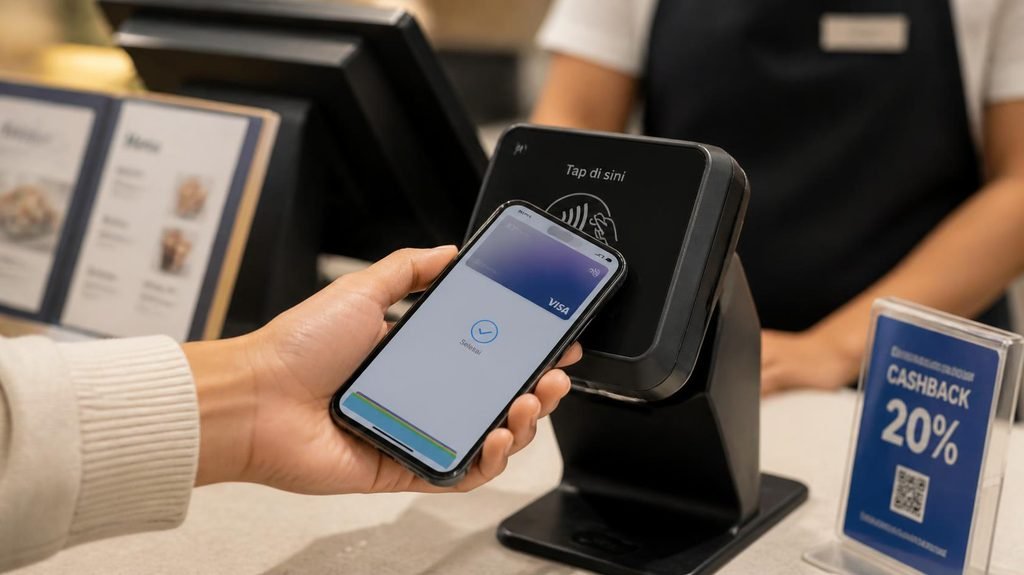
There’s a moment of quiet anxiety familiar to everyone: you tap your phone or card on the payment machine, it beeps instantly, and you walk away thinking — “wait, did I just… broadcast my money through the air?”
It’s a reasonable fear. It’s also almost entirely wrong — but the real risks are interesting. Let’s separate the fear from the facts.

- With Square Terminal, you can ring up sales, accept payments, and print receipts, all with one device. Use it at the cou…
- Accept all major credit and debit cards and pay one low rate with no hidden fees and no long-term contracts.
- Process chip cards in just two seconds.
Fear #1: “My card details are flying through the air and anyone can catch them.”
Fact: The technology (NFC) has a range of about 4 centimeters. Not 4 meters — 4 centimeters. A criminal “sniffing” your tap-to-pay would need to be physically pressed against your pocket with a reader, in public, for several seconds. The physics alone makes electronic pickpocketing closer to a myth than a threat.
Fear #2: “Tapping sends my actual card number to the machine.”
Fact: This is the genuinely brilliant part. Tap-to-pay uses tokenization: your real card number never leaves your phone. Each transaction generates a one-time-use substitute number, valid for that single payment, useless if stolen.
Compare that to the old magnetic stripe — which literally printed your real card number and let any reader copy it. And compare it to handing your physical card to a waiter who disappears with it for five minutes. Tap-to-pay is arguably the safest common payment method in history, not the most dangerous.
Fear #3: “What about public WiFi?”
Fact: Tap-to-pay doesn’t use WiFi at all. The phone-to-terminal link is NFC; the terminal’s connection to the bank is the merchant’s problem, encrypted by the payment networks. Your payment is unaffected by the coffee shop’s WiFi.
So what IS actually at risk? The honest list:
1. Losing an unlocked phone. The weakest link isn’t the payment tech — it’s the lock screen. Wallet apps require a fingerprint or face scan per payment for a reason. No screen lock = someone who finds your phone can tap until limits stop them. Fix: a screen lock, always.
2. Shoulder surfing your PIN. The machine asking for your PIN at some taps? That’s the card network adding friction above a spending threshold. Cover the keypad like it’s an ATM — because it is one.
3. The card-versus-phone gap. A physical contactless card tapped by a thief works without any verification (small amounts). A phone wallet requires your face or finger every time. On pure security, the phone beats the plastic card. If you lose both on the same day, the phone is the safer of the two.
4. Fake terminals. Extremely rare, but real: a criminal device that imitates a card reader. Mitigations: transaction alerts on your banking app (spot anything odd in seconds), and remember that with tokenized payments, fraud liability for consumers is close to zero with card networks’ protections — disputed charges get refunded.
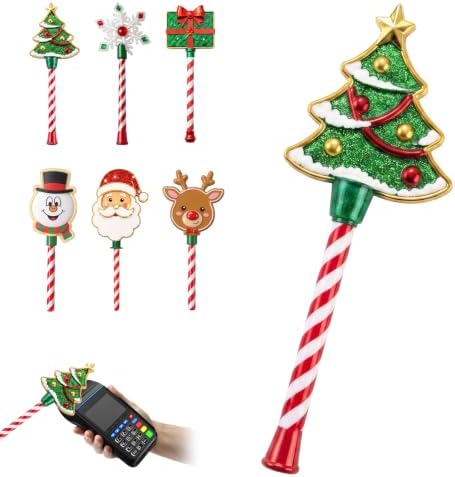
- Create magical Christms moments.Turn everyday payments into a fun and magical holiday experience. Simply place your card…
- Experience the magic of tap-to-pay.Simply insert your credit card, debit card, or compatible card into the built-in slot…
- Festive Christmas designs.Featuring a variety of classic Christmas elements, including Christmas trees, Santa Claus, sno…

- Perfectly designed – Our shopping bag is designed to safely store for Shopify tap & chip card reader and its charging ca…
- Secure and stable – The built-in elastic strap ensures that the card reader for iphone stays in place even when it’s bei…
- Holds more – There is a handy mesh pocket on the other side of the bag for storing the charging cable. This way, when yo…

- Universal Card Compatibility: Fits most standard contactless credit and debit cards securely for everyday transactions
- Novelty Wand Design: Features a humorous Sugar Daddy themed wand design that adds personality to your payment experience
- Contactless Payment Ready: Easy tap-to-pay functionality allows quick and convenient transactions without removing your …
📱 Tap vs. Swipe vs. Insert — Which Is Actually Safest?
Table
| Method | Your Real Number Exposed? | Clonable? | Extra Protection |
|---|---|---|---|
| Magnetic Swipe | ✅ Every time — same fixed number | Very easy | None |
| Chip Insert | ❌ Uses one-time codes | Extremely hard | PIN required above limit |
| Physical Card Tap | ❌ Uses one-time codes | Extremely hard | Amount limits apply |
| Phone Wallet Tap | ❌ Tokenized — number never exposed | Effectively impossible | Biometrics + amount limits |
Phone wallet taps are the safest way to pay. They combine the strongest encryption with something only you can provide — your fingerprint or face.
✅ Your Simple Safety Checklist
Table
| Habit | Why It Matters |
|---|---|
| Prefer phone wallets over physical cards | Adds biometric lock + never shares real number |
| Check the amount before tapping | Stops pressure scams & wrong charges |
| Turn on instant transaction alerts | You’ll know the second something unusual happens |
| Report lost cards immediately | Small taps can add up fast otherwise |
| Ignore “wallet locked” texts/emails | Real providers never ask for codes via messages |
| Keep phone software updated | Security patches fix the gaps |
💡 Final Thought
Tap-to-pay is not perfect — but it is genuinely safer than swiping or handing your card to someone. The technology was designed to fix exactly the weaknesses that made old payment methods so vulnerable.
The risks that remain aren’t about the beep or the signal — they’re about the human side: losing a card, trusting a message you shouldn’t, or rushing past the numbers on the screen.
So tap with confidence. Enjoy the speed. Just remember: the safest way to pay isn’t about magic technology — it’s about staying alert, checking the numbers, and keeping your phone locked. That’s the protection no hacker can get past.
The security theater to skip:
RFID-blocking wallets. Sold on fear (“protect yourself from electronic pickpockets!”) for a crime that is vanishingly rare, against a technology (RFID cards) that most banks replaced years ago with the much safer NFC tokenization described above. A tinfoil wallet for a threat that mostly no longer exists.
The verdict:
Tap to pay is a rare case where the newer, more convenient thing is also the safer thing — tokenized, short-range, biometric-locked. The practices actually worth your worry are the ones where payment is irreversible and untraceable: wire transfers, gift cards as payment, and bank transfers to strangers. Those are the payment methods fraudsters demand — which is exactly why we flag them as hard stops in our website safety checklist.
Use the tap. Lock the screen. Set up transaction alerts. That’s the entire playbook.
Affiliate link — “Earns commission at no extra cost to you.